
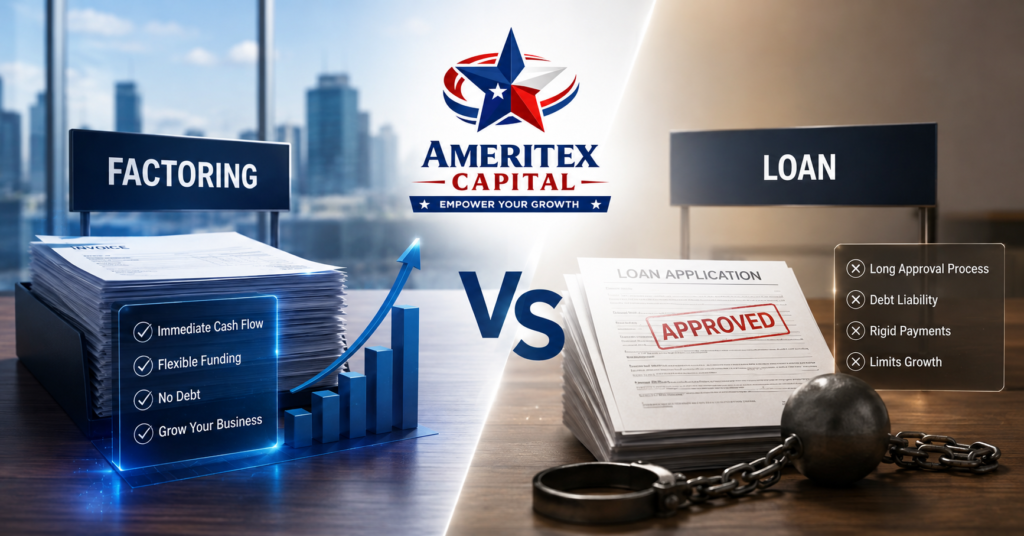
Business owners often assume invoice factoring is just another type of loan. It isn’t — and that distinction matters. Understanding factoring vs loan financing can determine whether your business takes on debt or simply accelerates cash it has already earned.
Ameritex Capital breaks down exactly how factoring differs from traditional bank lending, so you can decide which option truly fits your business.
How Bank Loans Work
Banks are in the business of lending money, and lending comes with strings attached. Most loans require collateral, which can be a dealbreaker for small businesses or startups without significant assets. Federal regulations also cap how much a bank can advance — typically 30% to 50% of a business’s needs. And once approved, that loan becomes a liability on your balance sheet, whether or not it fuels growth.
How Factoring Works
Factoring operates on a completely different model. Rather than lending you money, Ameritex Capital purchases your outstanding invoices at a discount. There’s no collateral to pledge, no debt created, and no artificial cap on your advance — qualified businesses can receive up to 90% of invoice value upfront, depending on the payer’s credit profile.
4 Reasons Factoring Isn’t a Loan
- No debt is created. Factoring is a sale of an asset — your invoices — not a borrowing transaction.
- Nothing to repay. Ameritex Capital collects directly from your customer, so there’s no repayment schedule on your end.
- It’s already your money. The advance simply gives you earlier access to revenue you’ve already billed.
- The collection risk transfers. Once factored, Ameritex Capital owns the responsibility of collecting the invoice — not you.
Factoring vs. Loan Comparison
| Feature | Factoring | Loan |
|---|---|---|
| What it is | Selling unpaid invoices at a discount | Borrowing money that must be repaid |
| Repayment | None — your customer pays the factor directly | Fixed payments plus interest |
| Balance Sheet Impact | No liability added | Recorded as a debt/liability |
| Collateral | Your invoices secure the transaction | Often requires additional collateral |
| Qualification | Based mainly on your customers’ credit | Based on your business’s credit and financial history |
Which Option Is Right for Your Business?
If your business needs predictable cash flow without adding liabilities to your balance sheet, factoring is likely the better fit. If you need long-term capital for major investments and can meet a bank’s collateral and credit requirements, a loan may make more sense.
Want a clearer picture of your options? Get a free rate quote from Ameritex Capital and see how much of your unpaid invoices you could unlock today.
Our team of factoring experts stand ready to answer any questions you may have about invoice factoring. Contact Us today or better yet, give us a call now and speak with one of our knowledgeable Business Development officers. You’ll be glad you did.